


Life Processes Class 10 Notes | Nutrition & Photosynthesis Explained (Part 2)
Introduction
In continuation of Life Processes, this part focuses on heterotrophic nutrition and digestion, which are essential for understanding how organisms obtain and process food. While plants prepare their own food, animals and humans depend on other sources for nutrition.
In this blog, we provide clear and structured notes on heterotrophic nutrition, digestion in microorganisms, and the human digestive system. These notes are designed to help Class 10 students understand concepts easily and prepare effectively for exams.
In this part, you will learn:
Types of heterotrophic nutrition
Nutrition in Amoeba and Paramecium
Human digestive system (mouth to intestine)
Important enzymes and their functions
📺 Watch the video explanation below for better understanding.
🎥 VIDEO SECTION
Heterotrophic Nutrition
Heterotrophic nutrition is a mode of nutrition in which organisms depend on other organisms for their food. These organisms cannot prepare their own food and rely on plants or other animals for energy.
Types of Heterotrophic Nutrition
Heterotrophic nutrition can be classified into three types:
1. Saprotrophic Nutrition
Organisms obtain food from dead and decaying matter.
They secrete digestive enzymes outside the body
Convert complex substances into simpler forms
👉 Example:
Mushroom
2. Parasitic Nutrition
Organisms derive food from a living host.
The host is harmed in this process
Parasites depend completely on the host
👉 Example:
Leech
3. Holozoic Nutrition
This is the most common mode of nutrition in animals.
Organisms consume solid food
Food is digested into simpler substances
👉 Example:
Humans
Nutrition in Unicellular Organisms
Amoeba
Amoeba takes in food through a special process:
Uses temporary finger-like projections called pseudopodia
Surrounds and engulfs food
Forms a food vacuole
Inside the vacuole:
Food is digested
Nutrients are absorbed into cytoplasm
Undigested food is expelled
Paramecium
Food enters through a specific region called oral groove
Hair-like structures called cilia help move food

Nutrition in Human Beings
Human digestion occurs in the alimentary canal, a long tube extending from mouth to anus.
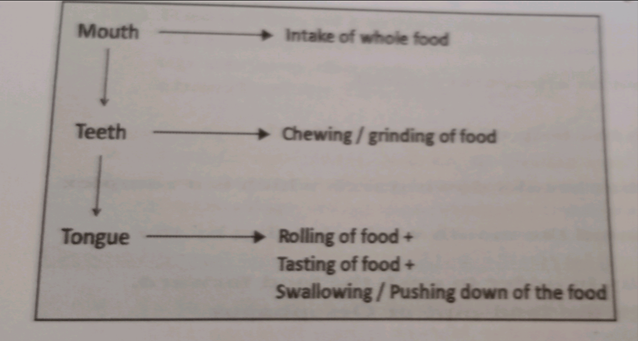
1. Mouth
Digestion begins in the mouth.
Food is chewed by teeth
Mixed with saliva
Tongue helps in mixing
Important Points:
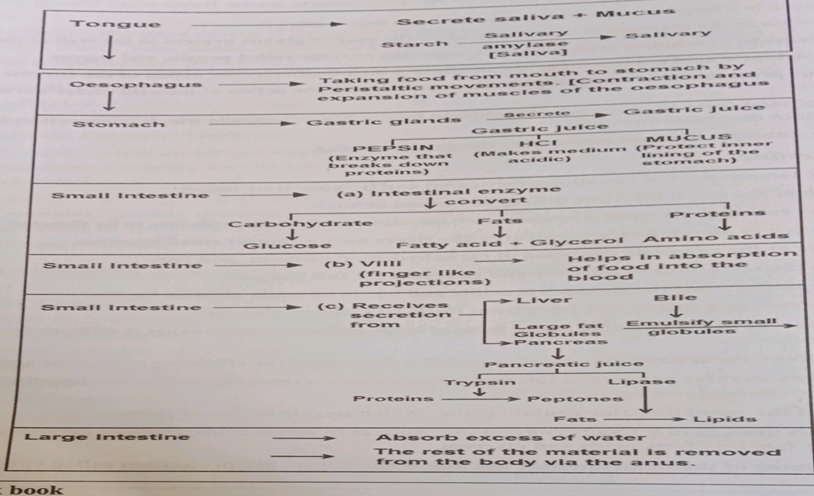
Saliva contains salivary amylase
Breaks down starch into simple sugars
Food moves to oesophagus through muscular movements
2. Oesophagus
Food pipe connecting mouth and stomach
Moves food using peristalsis (muscular movement)
3. Stomach
The stomach is a muscular organ where digestion continues.
Gastric glands release:
Hydrochloric acid (HCl) → Creates acidic medium
Pepsin → Digests proteins
Mucus → Protects stomach lining
👉 Food is released slowly into the small intestine.
4. Small Intestine
This is the most important part of digestion.
Long and coiled structure: This is the longest part of the alimentary canal and is extensively coiled
Site of complete digestion :The length of the small intestine differs in various animal
Herbivores eating grass need a longer small intestine to allow the cellulose to be digested
Meet is easier to digest and carnivorous like tigers have a shortest small intestine
It is the site of the complete digestion of carbohydrate proteins and fats
It received the secretion of the liver and pancreas for this purpose
The food coming from the stomach is acidic and has to be made Alkaline
Pancreatic enzymes to act by juice from the liver accomplishes this
Fats are present in the intestine in the form of large globules which makes it difficult for enzymes to act on them
Bile salts break them down into smaller globules increasing deficiency of enzyme action
The pancreas secrete pancreatic juice which contains enzymes like trypsin for digesting proteins and lipase for Breaking Down emulsified fats
Key Functions:
Receives bile from liver
Receives pancreatic juice
Digestion Process:
Proteins → Amino acids
Carbohydrates → Glucose
Fats → Fatty acids + Glycerol
Role of Bile and Enzymes
Bile salts break large fat globules into smaller ones
Pancreas releases enzymes:
Trypsin → Digests proteins
Lipase → Breaks fats
Villi (Very Important)
The inner lining of small intestine has finger-like projections called villi.
Functions:
Increase surface area
Help in absorption of nutrients
Rich in blood vessels
5. Large Intestine
Absorbs water from undigested food
Remaining waste is removed through anus
IMPORTANT QUESTIONS
1. What is enzyme?
👉 Biological catalyst that breaks complex substances into simpler ones
2. Sequence of alimentary canal:
👉 Mouth → Oesophagus → Stomach → Small intestine → Large intestine
3. Which part receives bile?
👉 Small intestine
4. First enzyme in digestion?
👉 Salivary amylase
5. Function of villi:
Increase absorption
Transport nutrients to body

6. Why small intestine is longer in herbivores?
👉 To digest cellulose in plants
7. Functions of digestive components:
Hydrochloric acid → acidic medium
Pepsin → protein digestion
Bile salts → fat breakdown
Trypsin → protein digestion
Lipase → fat digestion
8. What will happen if mucus is not secreted by the gastric gland
👉Fails to protect the inner lining of the stomach from the action of the acid under normal condition
9. How small intestine design to absorb digested food
👉 The inner lining of the small intestine has numerous finger like projection called villi.These villi absorb the digested food
10. Small intestine in herbivorous longer than in carnivores give reason
👉 Herbivores eating grass need a longer small intestine to allow the cellulose to be digested
11. An enzyme secreted from gastric glands in stomach that acts on protein is
👉 Pepsin
12. Identify the labelled parts P,Q and R in the given diagram below explain how the digestion takes place in the part Q and R

👉 P= Oesophagus
Q = Stomach
R = Small intestine
In stomach it releases hydrochloric acid, pepsin and mucus. Acid helps to maintain the acidic medium, mucus helps to protect the inner lining of stomach, pepsin helps to digest the protein
Small intestine : Complete digestion will takes place in small intestine it converts protein into amino acid,carbohydrate into glucose and fats into fatty acid and glycerol.


Comments