


Life Processes Class 10 Notes | Respiration in Humans, Plants & Animals (PART 3)
Introduction
Respiration is one of the most essential life processes that helps organisms release energy from food. Without respiration, cells cannot perform vital functions required for survival.
In this part of Life Processes, we will understand breathing, cellular respiration, aerobic and anaerobic respiration, and how respiration occurs in plants and animals. These concepts are very important for Class 10 exams and help build a strong foundation in Biology.
📘 In this part, you will learn:
Difference between breathing and respiration
Steps of cellular respiration
Aerobic and anaerobic respiration
Respiration in plants and animals
Important exam questions
📺 Watch the video below and read the notes for better understanding
🎥 VIDEO SECTION
📌 Respiration
Respiration is the process by which organisms take in oxygen from the environment and use it to break down food to release energy. This energy is essential for all cellular activities.
Respiration includes both breathing (external process) and cellular respiration (internal process).
Breathing vs Respiration
Breathing is the physical process of inhaling oxygen and exhaling carbon dioxide
Respiration is the chemical process of breaking down food to release energy
Cellular Respiration
Cellular respiration occurs inside cells and involves the breakdown of glucose to release energy.
Steps involved:
Glucose molecules are broken down into pyruvic acid
Glucose molecule is composed of six carbon atom while pyruvic acid is composed of three carbon atoms
Pyruvic acid::In mitochondria further breaking down of pyruvic acid takes place and the molecules formed depend on the type of respiration in a particular organism

Types of Respiration
Respiration is of two types:
1. Aerobic Respiration
Occurs in the presence of oxygen
Complete breakdown of food
Produces:
Carbon dioxide
Water
Releases more energy
👉 Occurs in:
Humans
Higher animals
Anaerobic Respiration
Occurs in the absence of oxygen
Partial breakdown of food
Produces:
Ethyl alcohol / Lactic acid
Carbon dioxide
Releases less energy
👉 Occurs in:
Yeast
Bacteria
Muscle cells (during heavy exercise)
Muscle Cramps (Important Concept) : Sometimes lactic acid formed during anaerobic respiration in muscle cells get accumulated causing muscular cramps
During intense exercise:
Oxygen supply becomes insufficient
Glucose breaks down anaerobically
Lactic acid accumulates
👉 This causes muscle cramps
Respiration in Plants
Plants also respire continuously, both during day and night.
Key Points:
All parts of plants perform respiration
Gas exchange occurs through:
Stomata (leaves)
Lenticels (stems)
Roots absorb oxygen from soil
Additional Points:
Oxygen diffuses into cells
Carbon dioxide is released
During the day:
Oxygen from photosynthesis is used
Excess oxygen is released
Respiration in Animals
Different animals have different respiratory mechanisms.
Example: Fish
Take in water through mouth
Pass it over gills
Dissolved oxygen is absorbed into blood
👉 Aquatic organisms breathe faster because:
Water has less oxygen compared to air
Human Respiratory System (Important)
Air passes through the following path:
👉 Nostrils → Pharynx → Larynx → Trachea → Alveoli
Role of Alveoli
Alveoli are tiny balloon-like structures in lungs.
Functions:
Increase surface area for gas exchange
Rich in blood vessels
Oxygen diffuses into blood
Carbon dioxide diffuses out
IMPORTANT QUESTIONS (EXAM FOCUS)
1. Sequence of air passage:
👉 Nostrils → Pharynx → Larynx → Trachea → Alveoli
2. Why do aquatic organisms breathe faster?
👉 Due to low oxygen availability in water
3. Difference between aerobic and anaerobic respiration?
Aerobic | Anaerobic |
Oxygen present | No oxygen |
Complete breakdown | Partial breakdown |
More energy | Less energy |
4. Why do runners get muscle cramps?
👉 This is a due to the absence of oxygen in the muscles and the liberation of lactic acid in muscle leads to muscle cramps
5. How are lungs designed for gas exchange?
Presence of alveoli
Large surface area
Rich blood supply
5. How are lungs design in human being to maximize the area of exchange of gases
👉 Within the lungs the passage devide into smaller and smaller tubes which finally terminate into balloon like structure which are called alveolie.The alveolie provide a surface where the exchange of gases can takes place. The walls of the alveoli contain an extensive network of blood vessels. The blood bring carbon dioxide from the rest of the body for release into the alveoli and oxygen in the alveolar air is taken up by the blood in the alveolar blood vessel to be transported to all the cells in the body
6. How does aerobic respiration differ from anaerobic respiration
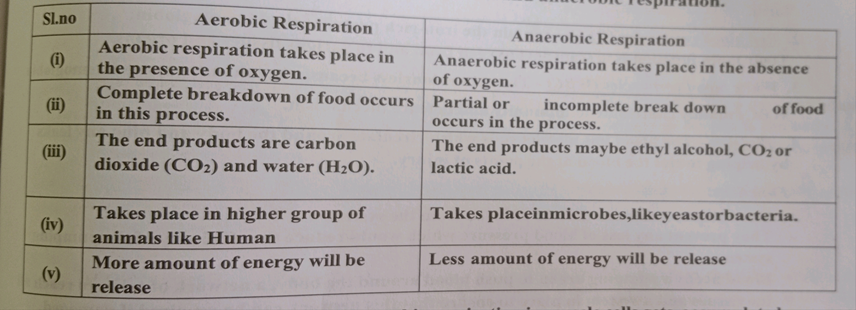
7.. Explain the three Pathways of Breaking Down in Living Organism

8. Rate of breathing in aquatic organism much faster than interested organism
This is because the amount of dissolved oxygen is low compared to the amount of oxygen in the air
9.Differences between aquatic and Terrestrial organism in relation to respiration
Terrestrial organism | Aquatic organism |
Organism live on land | Organism live inside water |
Presence of oxygen is more | Take oxygen from dissolved in water and presence of oxygen is less |
No need to respire fast | Need to respire fast |
No adaptation for respiration | More adaptation for respiration |
Ex: Human | Ex: Fish |


Comments